What I set out to build
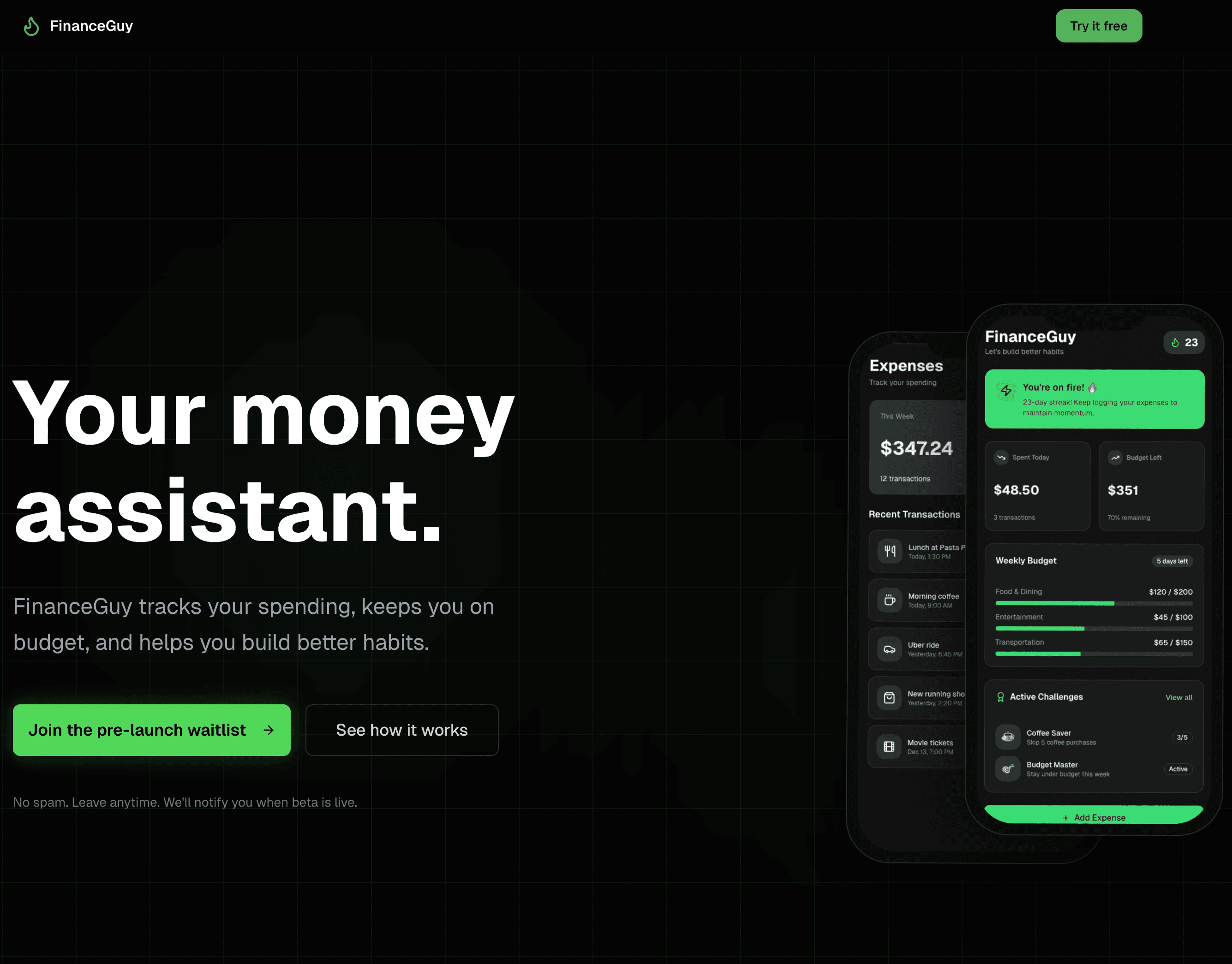
Most finance apps are good at explaining where money went after the fact. I wanted to experiment with a product that could also help around the decision itself, while still doing the normal work of tracking transactions, patterns, and personal financial context.
My contribution
- Worked across the mobile product, frontend, backend, and data layers as co-founder and lead developer.
- Built transaction imports, review, categorisation, and duplicate handling.
- Connected budgets, goals, and spending-pattern guidance to Supabase-backed data.
- Experimented with ML features alongside the existing rules-based workflows.
Problem & approach
FinanceGuy became an end-to-end product rather than a single ML feature. I worked across the mobile interface, authentication, data model, transaction workflows, analytics, and experiments around personalised ML-driven insights. A lot of the useful learning came from the unglamorous parts: edge cases, data quality, product decisions, and getting separate pieces to behave like one application.
How it works
- 01
Bring in transactions
Bring user/transaction data into the application.
- 02
Store & organise
Store and organise it in a personal-finance data model.
- 03
Calculate patterns
Calculate useful financial summaries and behavioural signals.
- 04
Calculate guidance
Use budget pressure and recurring spending patterns for current guidance. The separate LightGBM training experiment uses synthetic data.
- 05
Show guidance
Surface the result through a mobile interface aimed at an actual decision.
Data & evaluation
Data & inputs
Transaction imports, category history, budget cycles, and user-entered goals. The separate LightGBM experiment uses synthetic training data.
How it was evaluated
Current spending guidance is based on rules and patterns. The experimental Python training path writes a placeholder ONNX artifact; it is not a validated deployed ML model.
Results & progress
- In development
- Product status
- Mobile + web
- App & product site
- Experimental
- ML work
- Built transaction import, review, categorisation, and duplicate-handling workflows.
- Connected budget-cycle calculations and goals to Supabase-backed data.
- Kept the product site available while the mobile application continues in development.
Screenshots
Limits & lessons
Limitations
- The mobile application is still in development.
- Current spending guidance uses rules and patterns. The experimental LightGBM path writes a placeholder ONNX artifact and is not a validated deployed model.
What I learned
- FinanceGuy taught me that product engineering is mostly about trade-offs. A clever model does not matter if onboarding is confusing, the data is unreliable, or the feature does not help at the moment the user needs it.
Next steps
- Keep simplifying the product around the decisions that are actually useful to users.
- Improve data reliability and personalisation.
- Measure whether interventions help instead of adding features for their own sake.