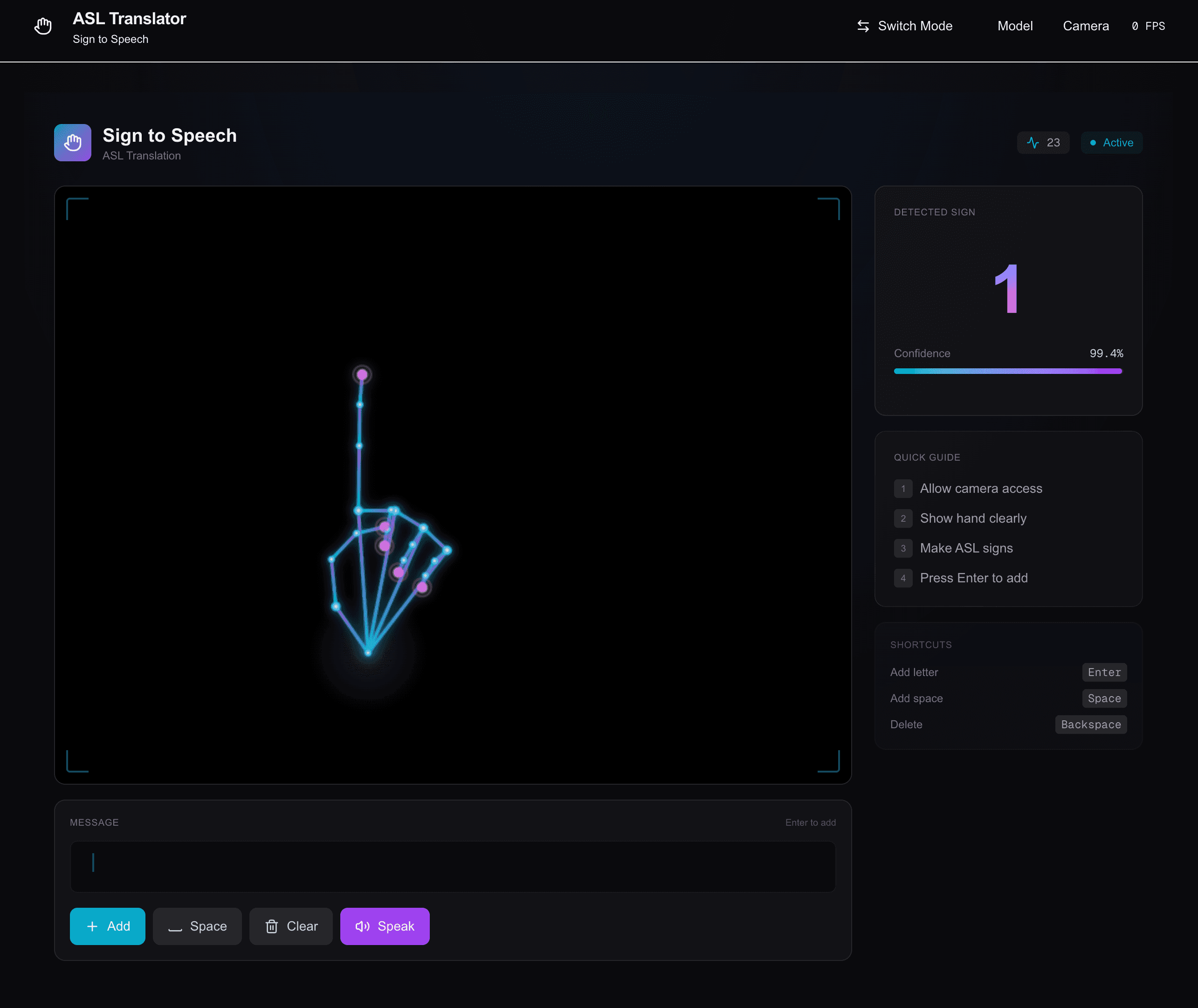
Can a webcam turn a hand gesture into useful interface feedback?
I wanted to see what happens when a small computer-vision model has to live inside an actual product. Training a classifier was only the first part; the harder part was getting webcam input, hand landmarks, inference, confidence handling, and the interface to work together in real time.
My contribution
- Worked on the gesture-classification pipeline.
- Connected MediaPipe hand landmarks to browser inference.
- Integrated the classifier into the web interface with confidence feedback and sentence assembly.
- Worked on application integration and the separate FastAPI text-to-sign workflow.
Problem & approach
I worked on a gesture classifier using hand landmarks from MediaPipe and connected it to a web interface as part of a 36-hour team hackathon. Instead of stopping at a notebook result, I worked through the path from camera input to a prediction the user could see and use. The browser runs the trained Keras model through TensorFlow.js; a separate FastAPI service handles text-to-sign generation.
How it works
- 01
Capture
Capture the user’s hand from the webcam.
- 02
Track landmarks
Use MediaPipe to extract hand landmarks.
- 03
Normalise
Transform the landmarks into the format expected by the classifier.
- 04
Predict
Run the trained model and obtain a class/confidence prediction.
- 05
Respond
Surface that prediction in the web interface.
Data & evaluation
Data & inputs
A limited 37-class landmark dataset. The frontend uses the same coordinate representation expected by the classifier.
How it was evaluated
The training notebook records 93.41% held-out test accuracy, rounded to 93.4%. This measures classification on the test samples, rather than unrestricted live sign-language interpretation.
Results & progress
- 93.4%
- Test Accuracy
- 37
- ASL Gestures
- 6,600+
- Training Samples
A label and confidence from 37 gesture classes
- 37 gesture classes.
- Approximately 93.4% test accuracy on the project evaluation set.
- Working browser-based prototype.
Screenshots
Limits & lessons
Limitations
- SilentSpeak is a prototype, not a clinically validated assistive product. Test accuracy describes the project dataset and does not establish real-world accessibility performance.
What I learned
- This project pushed me toward ML engineering. A model becomes much more interesting once it has latency, interface, confidence, and integration constraints around it. I also learned that a good offline metric does not automatically mean the live experience feels good.
Next steps
- Test robustness under different lighting, camera angles, and users.
- Improve confidence handling and out-of-distribution behaviour.
- Reduce friction in the live interaction flow.